What is Keyword Density in SEO? Why It Matters Less Than You Think
The number for density is a check at the end not something I aim for.
This difference is important because trying to get a “perfect” number usually causes problems. When you write with a percentage, in mind you end up using the exact same keyword in places where a different word or a related hrase would make more sense. The outcome is writing that seems stiff, boring and the same over and over again. Which is what you do not want for people reading it and for search engines that are trying to understand how much you know about the topic
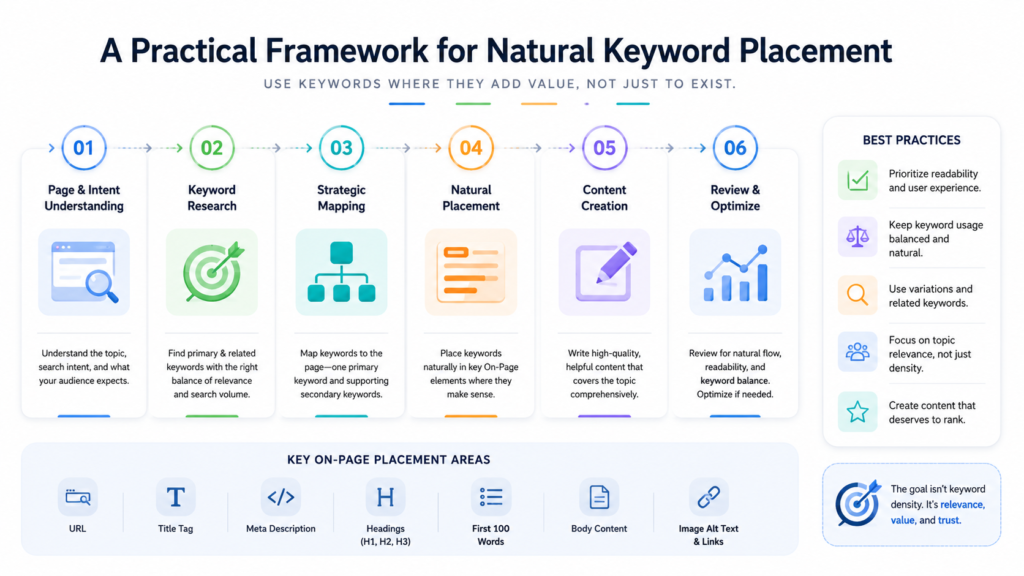
A Practical Framework for Natural Keyword Placement
Of thinking about how much something contributes to a percentage here is the rule of thumb I really use when I am working on a page
These areas are the most important for people who are looking at the page and for search engines that are looking at the structure
Let different versions and other ways to say the same thing cover the rest of the writing Once the keyword is placed in the important areas related words and normal way of speaking fill in the rest of the text not the exact same words over and over again
Do a check for the language If putting a keyword in a place feels strange when you say it loud it probably is Change it to something that sounds natural Readability is more important than repeating the exact same words
This way you end up in a good range without ever trying to reach a specific number
Thinking about density, as something that helps with rankings It is not that It is a sign of good or bad writing not something you can control directly.
KEYWORD DENSITY VS TROPICAL RELEVENCE
Topical Relevance
This is, about what the Factor measures.
The Factor looks at how a phrase is used.
It also checks how well a topic is covered and how deep the information goes.
This can affect the Ranking impact. It is not the main thing that affects it.
If you do not use the Factor much it has an effect.
If you use the Factor a lot it has a big effect.
If you use the Factor much it can be bad.
You might end up with Keyword stuffing, which makes your writing hard to read.
If you use the Factor just the right amount there is rarely a problem.
To make the Factor better you need to think about how to improve it.
The Factor is important when it comes to how a phrase is used and how well a topic is covered.
So you should try to improve the Factor to get a Ranking impact.
This means using phrases in a way and covering topics in a complete way.
By doing this you can improve the Factor. Make your writing better
.
ON -PAGE SEO NOTES (FOR PUBLISHING)
Not a number to engineer from the start.
External reference used: Googles Creating Helpful Content documentation (do-follow authoritative).
Image suggestions:
Placement 1 (after intro): A graphic showing the keyword density formula. Alt text: “keyword density in SEO formula explained.”
Placement 2 (in framework section): A visual of the 3-step placement framework.https://review.content-science.com/what-is-answer-engine-optimization-aeo/

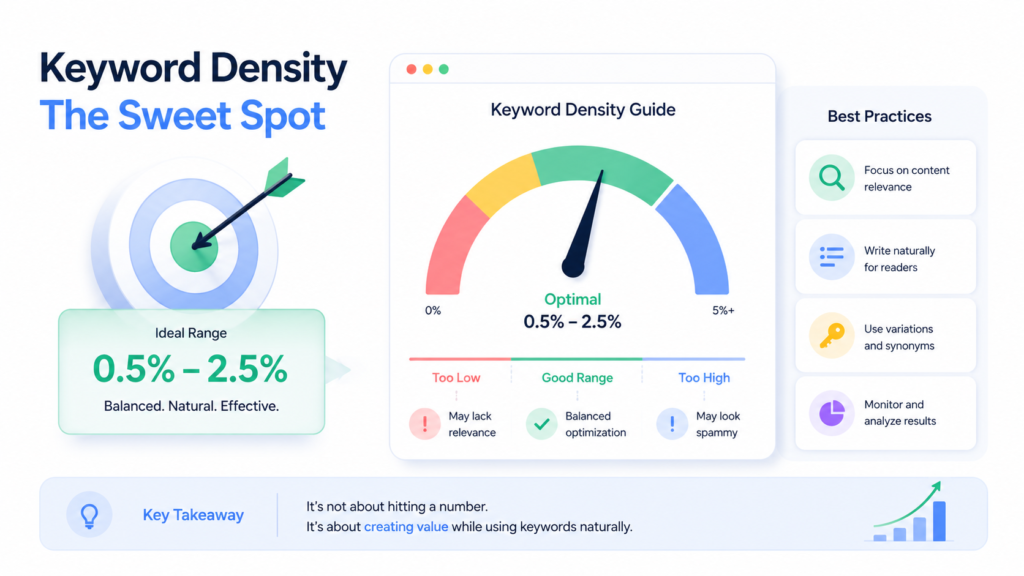
What is a good keyword density?
Density
Recommendation
0%
Keyword might not be present at all
0.5% – 1.5%
Generally safe and natural
1.5% – 2.5%
Usually acceptable if it sounds natural
3%+
Might start to become repetitive
5%+
Keyword stuffing risk
These are just guidelines, not hard and fast rules.
Example
Over-optimized (not good)
Keyword density in SEO is significant for keyword density in SEO ranking improvement.
It sounds unnatural.
Natural (good)
Knowing about keyword density in SEO will help writers place significant keywords naturally within their content, making it understandable and relevant to their readers.
Newer SEO strategy
Rather than repeating the keyword a lot, use:
Keyword: keyword density in SEO
Synonymous phrases: SEO keyword placement, on-page SEO, topical relevance, search intent, content optimization
Alternative words: keyword density calculator, ideal keyword use, natural keyword placement
It will help search engines understand the topic thoroughly.
Guidelines for keyword placement
Insert the keyword in:
Title tag
H1 header
First 100 words
One or two other headers (H2/H3)
Meta description
Alt text of images (if applicable)
URL slug (if applicable)
The best practice
Write it for the people
Ensure the answer to the query is comprehensive.
Place the main keyword early
In title, introduction and relevant header.
Conclusion: Treat Keyword Density as a Checkpoint, Not a Target
Keyword density in SEO can certainly be something to learn about, but it was never intended as the end point of the process. Employ it the way that an expert in SEO does, by putting your primary keyword in the right places, writing naturally, making use of synonyms and related words, and then doing a quick check on the density of your keyword once you’ve finished. In all likelihood, your keyword density will work out just fine if your article actually addresses the question that needs answering.
On- linking opportunity: Link to a related post on “on-page SEO checklist” or “how to do keyword research.”
Used external source for reference: Creating Helpful Content by Google (do-follow and authoritative).
Images recommended:
Image #1 (after the introduction): An image of the formula used in calculating the keyword density. Alternate text: “Keyword density formula in SEO explained.”
Image #2 (while discussing the framework): An illustration of a three-step framework used in prioritizing keywords’ placement. Alternate text: “Framework for natural keyword placement in SEO.”
Image prompts:
“Informative infographic featuring the calculation formula of keyword density, minimalist style, blue and white color theme.”
“Three-step flow diagram demonstrating the priority order of placing keyword: title, introduction, body.”
Video/image embed suggestion: A short screen recording demonstrating the use of keyword density in Yoast and Rank Math would be perfect right after the “How is Keyword Density Calculated?” section.
Schema suggestion: Article schema for the blog post and FAQ Page schema for the FAQ section for rich snippets https://alosiousnain.com/